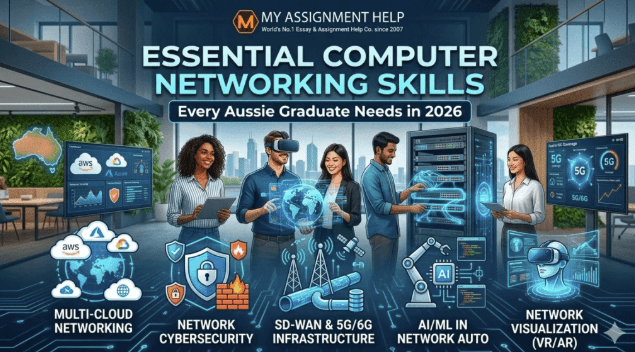
The Australian digital landscape is undergoing a massive transformation. As we move through 2026, the demand for robust network infrastructure has never been higher. With the Australian Government’s continued investment in the National Broadband Network (NBN) upgrades and the nationwide rollout of 6G trials, the stakes for new graduates entering the Information and Communications Technology (ICT) sector are incredibly high.
For graduates from top-tier institutions like UTS, RMIT, or UQ, a degree is no longer a guaranteed golden ticket. The industry now demands a blend of architectural theory and hands-on technical proficiency. Navigating the complexities of modern infrastructure—from SD-WAN to satellite integration—requires a proactive approach to skill acquisition. Many students find that professional networking assignment help is an effective way to bridge the gap between classroom theory and the technical rigour expected by Australian employers.
In a competitive market where “sovereign capability” and “cyber resilience” are the buzzwords of the year, being able to design, secure, and troubleshoot high-speed networks is essential. Whether you are aiming for a role in a Sydney-based fintech firm or a government agency in Canberra, mastering the following skills will define your career trajectory in 2026.
1. Network Automation and Programmability
Gone are the days of manual Command Line Interface (CLI) configurations for every single switch. In 2026, Australian enterprises rely on Infrastructure as Code (IaC).
- Python for Networking: You need to automate routine tasks using Netmiko or NAPALM.
- Ansible and Terraform: These tools are now standard for deploying consistent network configurations across hybrid environments.
- API Integration: Understanding RESTful APIs to allow different software-defined components to communicate is a non-negotiable skill.
2. Cybersecurity-First Networking (Zero Trust)
With the Australian Cyber Security Centre (ACSC) reporting a rise in sophisticated infrastructure attacks, networking and security have merged.
- Zero Trust Architecture (ZTA): Graduates must understand how to implement “never trust, always verify” protocols.
- SASE (Secure Access Service Edge): Combining WAN capabilities with cloud-native security functions.
- Identity Services: Skills in Cisco ISE or Aruba ClearPass for managing who and what gets onto the network.
3. Cloud Networking and Hybrid Integration
Most Australian businesses have moved away from purely on-premise servers.
- AWS & Azure Networking: Knowledge of VPCs, VNETs, Direct Connect, and ExpressRoute is vital.
- Cloud-Native Services: Understanding how to route traffic between a physical office in Melbourne and a cloud instance in the Sydney region.
- Multi-Cloud Strategy: Managing networks that span across different providers without losing connectivity or security.
4. 5G/6G and Edge Computing
Australia’s geographic layout makes edge computing uniquely important.
- Edge Architecture: Processing data closer to the source (mines in WA, farms in regional NSW) rather than sending everything to a central data centre.
- Wireless Site Surveys: Using tools like Ekahau to design high-performing wireless environments in complex architectural spaces.
See also: Omnichannel Retail Strategies
Data Insights: The Aussie ICT Market in 2026
According to recent Australian tech workforce reports, there is a projected shortfall of 15,000 networking specialists by the end of 2027.
| Skill Category | Market Demand (2026) | Avg. Starting Salary (AUD) |
| Network Automation | High | $85,000 – $98,000 |
| Cybersecurity/Zero Trust | Critical | $92,000 – $110,000 |
| Cloud Architect | High | $95,000 – $115,000 |
| Standard Support | Medium | $65,000 – $78,000 |
Source: Derived from ACS Australia’s Digital Pulse 2025/2026 Projections.
Balancing Theory with Practice
The transition from student to professional often involves a massive workload. Between internships and final-year projects, the pressure can be immense. It is common for students to seek reliable services to do my homework when technical lab reports or complex packet tracer simulations become overwhelming. Utilizing these resources allows graduates to focus on the high-level strategic skills that impress hiring managers during technical interviews.
5. Soft Skills for Technical Roles
In the Australian “flat” management culture, being a “tech hermit” doesn’t work anymore.
- Stakeholder Management: Can you explain to a CFO why a $200,000 firewall upgrade is necessary?
- Technical Documentation: Writing clear, concise SOPs (Standard Operating Procedures) is just as important as the configuration itself.
Key Takeaways for 2026 Graduates
- Embrace Coding: Networking is now a software discipline. Learn Python and YAML.
- Security is Central: Every network decision is a security decision. Study the ACSC Essential Eight.
- Get Certified: While degrees matter, vendor certifications (CCNA, CCNP, AWS Certified Advanced Networking) still hold massive weight in the Australian market.
- Regional Awareness: Understand the unique challenges of the Australian NBN and regional connectivity.
Frequently Asked Questions (FAQ)
Q: Is the CCNA still relevant for Australian graduates in 2026?
A: Absolutely. While the exam has evolved to include more automation and security, the foundational knowledge of routing and switching remains the “alphabet” of the industry.
Q: How much coding do I actually need to know?
A: You don’t need to be a software engineer, but you should be able to read and write scripts that automate repetitive configuration tasks and parse data from network devices.
Q: What is the biggest mistake new graduates make?
A: Ignoring soft skills. Many graduates can configure an OSPF area but struggle to write a professional project proposal or explain a network outage to a non-technical client.
Q: Where are the most jobs located?
A: While Sydney and Melbourne remain the primary hubs for fintech and corporate HQ, Brisbane and Perth are seeing massive growth in industrial networking for mining and energy sectors.
About the Author
Angelika S.
Senior Academic Consultant at MyAssignmentHelp
Angelika is a seasoned educator and content strategist with over a decade of experience in the Australian ICT sector. Holding advanced qualifications in Information Technology and Education, she specialises in bridging the gap between academic theory and industry requirements. At MyAssignmentHelp, Angelika mentors students through the complexities of modern computer science, ensuring they meet the rigorous E-E-A-T standards required for contemporary professional success.
References
- Australian Computer Society (ACS). (2025). “Australia’s Digital Pulse: Annual Report on the ICT Workforce.”
- Australian Cyber Security Centre (ACSC). (2026). “Strategies to Mitigate Cyber Security Incidents (The Essential Eight).”
- NBN Co. (2026). “The Evolution of Australian Connectivity: From 5G to 6G Satellite Integration.”
- Tertiary Education Quality and Standards Agency (TEQSA). (2025). “Graduate Outcome Survey: Engineering and IT Sector Analysis